Call Center

+91 702 579 0257

MRI Scan

MRI Scan

Overview

An MRI scan (Magnetic Resonance Imaging) is an advanced diagnostic imaging test that uses a strong magnetic field and radio waves to create detailed images of organs, soft tissues, nerves, and bones inside the body. Unlike CT scans or X-rays, MRI does not use radiation. MRI is especially useful for evaluating the brain, spinal cord, joints, muscles, heart, and internal organs. It helps detect tumors, nerve injuries, ligament tears, stroke, infections, and other complex conditions. The procedure is painless but may take longer than a CT scan, and in some cases, contrast dye is used to enhance image clarity.

Ideal For

An MRI scan is ideal for detailed evaluation of the brain and spinal cord, detecting tumors and soft tissue abnormalities, assessing ligament and muscle injuries, diagnosing stroke and nerve-related conditions, examining joint problems, and evaluating certain heart and blood vessel conditions, as it provides highly detailed images without using radiation.

Pre-Requisite

The procedure is safe and carefully monitored:

• Remove all metal objects including jewelry, watches, hairpins, and dentures before the scan.
• Inform the doctor if you have pacemakers, cochlear implants, metal implants, stents, or surgical clips.
• Fasting for 4–6 hours may be advised if contrast dye is required.
• Share your complete medical history, especially kidney problems or previous surgeries.
• Inform the staff if you experience claustrophobia, as assistance or mild sedation may be arranged if needed.

Process

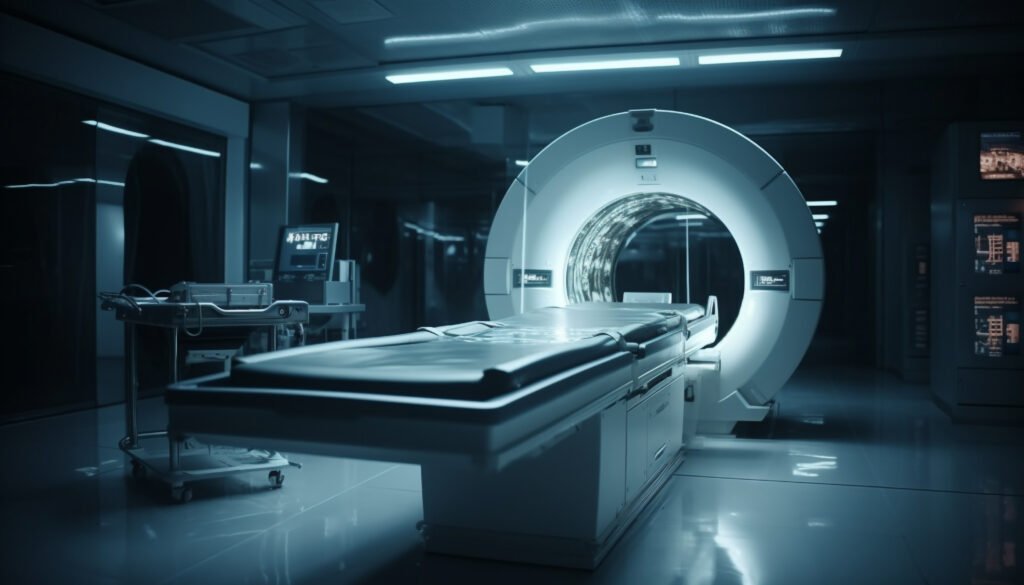
During an MRI scan, you will lie on a movable table that slides into a large, tunnel-shaped machine. The scanner uses strong magnetic fields and radio waves to capture detailed images of the body. You must remain still during the procedure, and you may hear loud tapping sounds while images are being taken. The scan is painless and usually takes 20–45 minutes, and contrast dye may be administered in some cases to enhance image clarity.

Popular Health Packages

When and Why CT Scan is Prescribed?

An MRI scan is prescribed when detailed images of soft tissues, nerves, and organs are needed to diagnose conditions that may not be clearly visible on X-rays or CT scans. Doctors commonly recommend it to evaluate brain and spinal cord disorders, detect tumors, assess joint and ligament injuries, diagnose stroke, investigate persistent pain, and monitor certain chronic or neurological conditions.

Things You Should Know

• MRI does not use radiation; it uses magnetic fields and radio waves.
• The machine can be noisy, and earplugs or headphones are usually provided.
• You must stay very still to obtain clear and accurate images.
• Inform the staff about any metal implants or medical devices before the scan.
• The procedure is painless, but it may take longer than a CT scan.

Frequently Asked Questions

MRI provides superior visualization of soft tissues, nerves, and the brain without using ionizing radiation, making it particularly valuable for neurological and musculoskeletal evaluation.
Contrast agents are used to improve the visibility of tumors, inflammation, blood vessels, or subtle tissue abnormalities that may not be clearly defined on routine images.
MRI may be unsuitable for patients with certain implanted medical devices or metallic fragments, and image quality can be affected by movement.
Advanced magnetic field technology and computer processing generate high-resolution, multi-plane images, provided the patient remains still throughout the procedure.
The detailed images assist physicians in accurate diagnosis, surgical planning, therapy monitoring, and long-term disease management.

Filters

Test Type

Health condition

Gender

Age Group

Filters

Package Type

Health condition

Gender

Age Group