
Home » Scans & Imaging » MRI Scan
Home » Scans & Imaging » MRI Scan
The procedure is safe and carefully monitored:
• Remove all metal objects including jewelry, watches, hairpins, and dentures before the scan.
• Inform the doctor if you have pacemakers, cochlear implants, metal implants, stents, or surgical clips.
• Fasting for 4–6 hours may be advised if contrast dye is required.
• Share your complete medical history, especially kidney problems or previous surgeries.
• Inform the staff if you experience claustrophobia, as assistance or mild sedation may be arranged if needed.
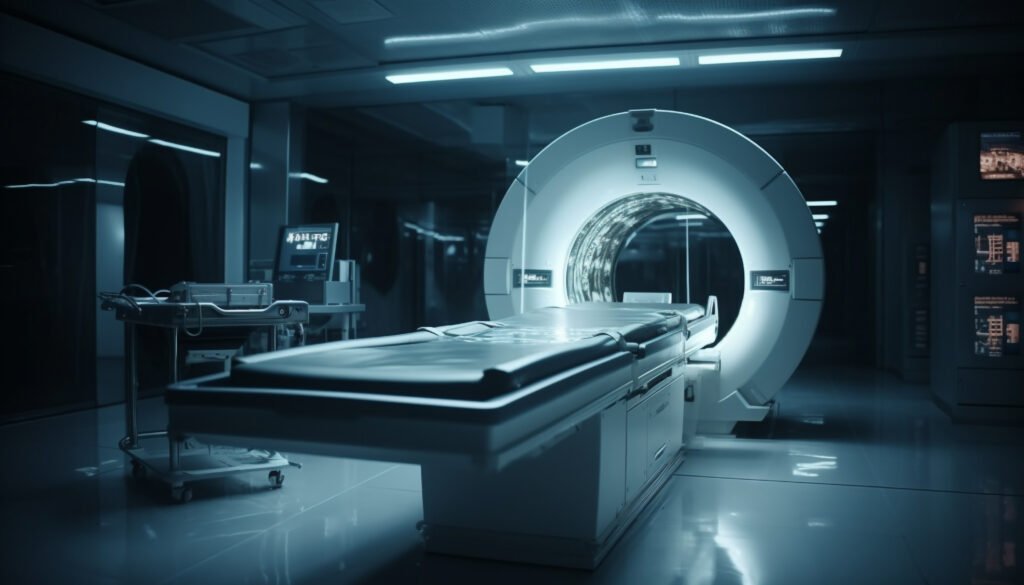
During an MRI scan, you will lie on a movable table that slides into a large, tunnel-shaped machine. The scanner uses strong magnetic fields and radio waves to capture detailed images of the body. You must remain still during the procedure, and you may hear loud tapping sounds while images are being taken. The scan is painless and usually takes 20–45 minutes, and contrast dye may be administered in some cases to enhance image clarity.
An MRI scan is prescribed when detailed images of soft tissues, nerves, and organs are needed to diagnose conditions that may not be clearly visible on X-rays or CT scans. Doctors commonly recommend it to evaluate brain and spinal cord disorders, detect tumors, assess joint and ligament injuries, diagnose stroke, investigate persistent pain, and monitor certain chronic or neurological conditions.
• MRI does not use radiation; it uses magnetic fields and radio waves.
• The machine can be noisy, and earplugs or headphones are usually provided.
• You must stay very still to obtain clear and accurate images.
• Inform the staff about any metal implants or medical devices before the scan.
• The procedure is painless, but it may take longer than a CT scan.